

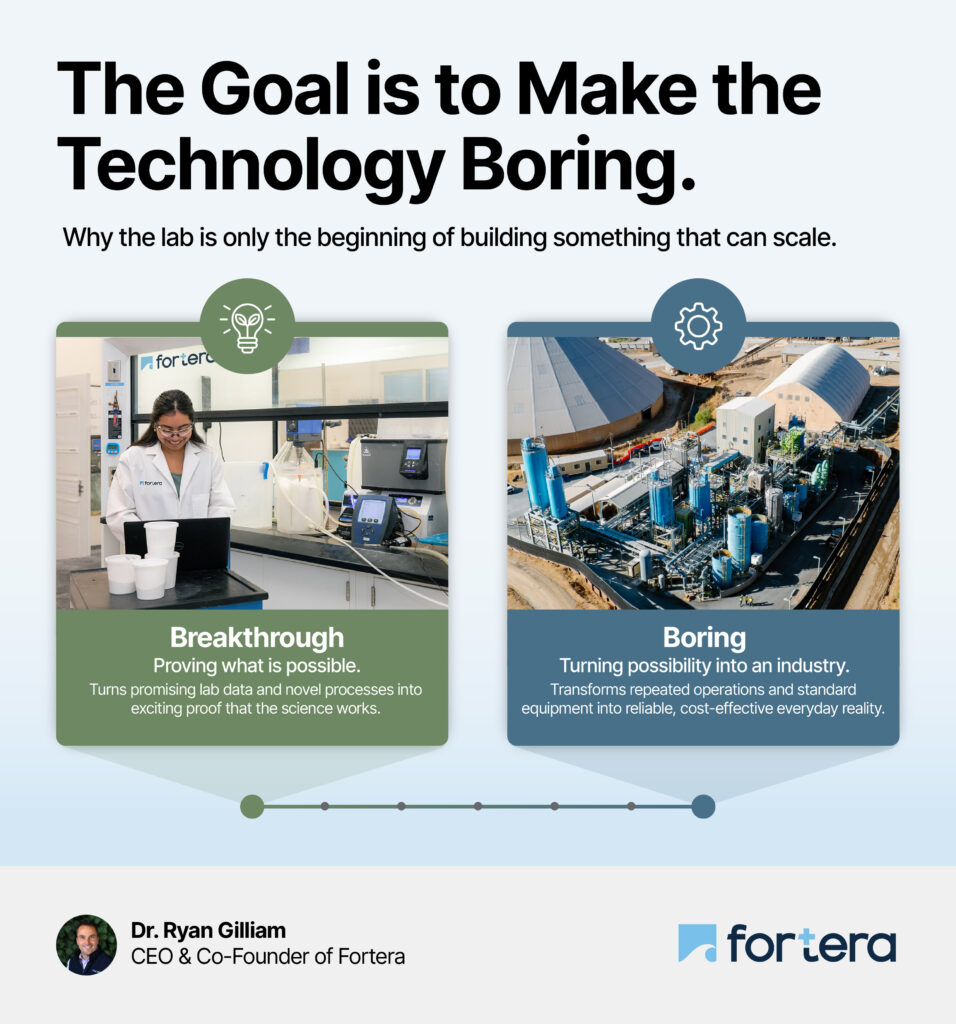
Let me start with a disclaimer: I love the lab.
I’ve spent most of my career developing new technologies, and there is nothing quite like seeing something work for the first time. The lab is where ideas become real. It is where you prove the chemistry, physics, or fundamental concept behind a technology.
It is essential.
But it is also just the starting line.
One of the easiest traps in technology development is confusing “it works” with “it scales.”
In the lab, you control almost everything. Consistent and high-purity feedstocks. Expensive analytics. Operating conditions that can be tightly managed. Run by scientists or engineers who understand exactly what is happening.
The real world is much less cooperative.
Feedstocks vary. Impurities foul equipment. Pumps fail. Sensors drift. Operators change from shift to shift. Waste streams appear that weren’t obvious at small scale. Solution concentrations drift.
This is when the small things that didn’t matter in the lab become the important thing while scaling.
The one lesson that has been remarkably consistent over my career is proving the science is only one part of proving the technology.
A successful lab experiment proves something is technically possible, but it does not prove it is scalable.
There is a huge difference between the two.
When the Lab Lies to You.
We have gotten very good at generating enough data to prove that something could technically work.
There is no shortage of impressive technology coming out of universities, national labs, startups, and corporate R&D groups.
New catalysts. New materials. New electrochemical processes. New ways to make fuels, chemicals, cement, steel, and just about everything else.
A lot of it works.
That isn’t the problem.
I’ve seen plenty of technologies where the chemistry was great, the pilot data looked promising, and the economics looked compelling in a presentation.
Then you try to turn the process into an actual plant.
One of the first technologies I helped develop was an electrochemical process designed to make acids and bases using less energy than traditional approaches. Those chemicals could then be used in CO2 capture, cement production, and a variety of other applications.
We had an incredible science team. We had thousands of hours of lab testing. We had worked through the cell design and partnered with one of the world’s leading electrode and cell companies.
We were ready.
Or at least we thought we were.
We spent millions building our first plant, including a 10-cell electrolyzer and another 10 individual cells for electrode and membrane development. We worked with an EPC firm on the design and construction and brought in an overseas team to help with assembly and commissioning.
Then we turned it on and we couldn’t get within an order of magnitude of the current density we had achieved in the lab.
The electrodes flooded. We had pressure problems. Electrical distribution issues. Flow problems.
It became painfully obvious that we had a lab full of very good electrochemists, but we didn’t know nearly enough about electrochemical engineering.
We eventually worked through those problems, but it was an eye-opening lesson in how different a small lab cell is from commercial equipment.
I learned the lesson again a few years later while developing a chemical technology for more sustainable plastics.
We spent years getting the chemistry right in the lab and eventually raised and spent millions building the first pilot facility.
Only after operating continuously did we discover that we were generating a by-product at parts-per-million levels. It looked insignificant in a short lab test.
At scale, over time, it accumulated in the system and eventually killed the process.
We ultimately had to change the chemistry, resulting in years of additional work.
Those experiences taught me something I have carried with me ever since. Just because something works in the lab, over short durations, on small equipment, does not mean it will scale.
And often, the thing that gets you isn’t the core technology.
It is the by-products. Feedstock impurities. Mechanical design. Heat transfer. Mass transfer. Kinetics. Materials of construction. Controls. Or some other seemingly mundane problem you may never have seen in the lab.
Those experiences changed how I think about developing technology.
My goal now is simple. Make the technology boring.
That probably sounds strange coming from someone who has spent most of his career developing new technology.
But I think one of the biggest mistakes we make is continuing to celebrate complexity long after we should be engineering it out.
Complexity can be exciting in a lab. But in a factory, it is usually a liability.
If your process requires highly specialized equipment, exotic materials of construction, extremely tight operating conditions, ultra-pure feedstocks, or a team of PhDs constantly adjusting it, you may have invented something remarkable.
But you probably haven’t invented something scalable yet.
The technologies that ultimately change industries tend to become boring.
Standard equipment. Low-cost materials of construction. Multiple suppliers. Simple feedstocks. Straightforward controls. Easy integration.
At some point, the technology has to stop being a science project and become an operating system.
That transition is much harder than it sounds.
As technologies mature, I think we need to start asking a different set of questions.
Where does the equipment come from? Are there multiple suppliers? Can a normal EPC firm design it? Can a normal construction company build it? Is the feedstock actually available at the price and scale modeled? Can someone other than the original technical team commission it? Can operators run it without calling headquarters every time something goes wrong?
And perhaps most importantly. Does it actually get cheaper and easier every time you build another one?
Because that is what scale is supposed to do.
I am still an optimist about technology. You probably have to be to spend your career building companies around things that haven’t existed before.
But optimism needs to be paired with intellectual honesty. It isn’t enough to prove something can technically work.
You have to prove that it can be manufactured, built, operated, maintained, financed, and repeated at the scale required to actually matter.
That is a much higher bar.
And I think we should embrace it.
The goal isn’t to keep technology exciting forever.
The goal is to make it boring.
Boring enough that EPC firms know how to build it.
Boring enough that banks know how to finance it.
Boring enough that operators know how to run it.
And boring enough that nobody thinks twice about building the next plant.
A Takeaway for Entrepreneurs
If you are going to use Technology Readiness Levels (TRL) to highlight how advanced your tech is, be intellectually honest about what level you are at. TRL 3 is essentially proof of concept in the lab. TRL 4 and 5 is when you start validating the technology at larger scale and under increasingly relevant conditions. TRL 6 and 7 are where you begin demonstrating that it can operate as a real system in the real world. That distinction matters. A successful lab result at TRL 3 is something to celebrate, but it is just the beginning of the journey. Most of the risks that ultimately determine whether you have a viable business are still ahead of you.
 A Takeaway for Entrepreneurs


